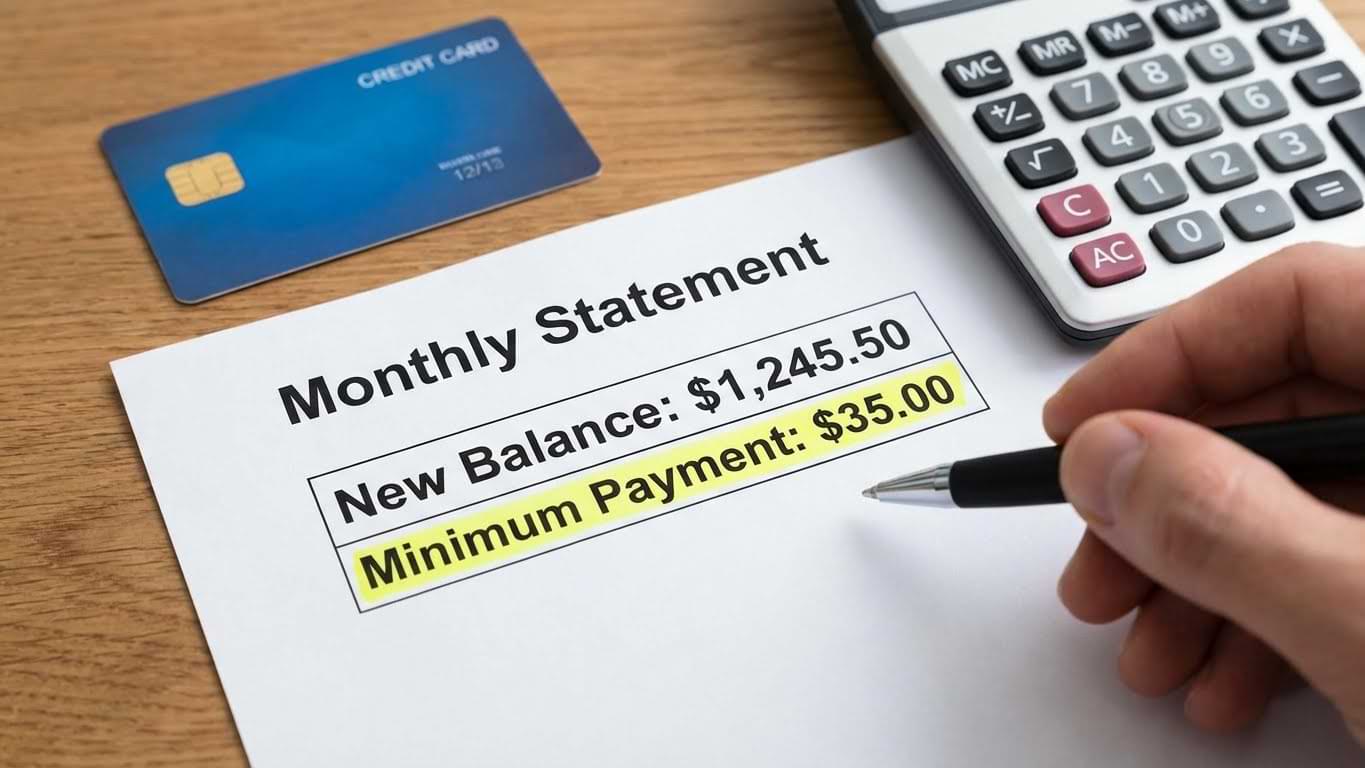
Credit cards are easy to use, fast, and convenient. But they can also become dangerous if you do not fully understand how payments work. One of the most misunderstood parts of credit cards is the minimum payment.
Many people believe that paying the minimum amount shown on their credit card bill is “good enough.” Technically, it keeps the account active. But financially, it can slowly push you into long-term debt.
In this article, we will clearly explain what a credit card minimum payment is, what really happens when you pay only the minimum, and why banks quietly benefit when you do this. Everything is explained in simple English, so even beginners can understand.
What Is a Credit Card Minimum Payment?
A credit card minimum payment is the smallest amount you must pay every month to keep your credit card account active and avoid late fees.
Usually, the minimum payment is:
-
2% to 5% of your total outstanding balance
OR -
A fixed amount (like $25 or ₹500), whichever is higher
This amount is clearly shown on your credit card statement.
High-search keywords:
credit card minimum payment, minimum amount due, minimum payment meaning
Why Do Credit Cards Have a Minimum Payment Option?
Banks introduced minimum payments to:
-
Make credit cards look affordable
-
Reduce missed payments
-
Encourage people to keep using credit
But the real reason is simple:
👉 Minimum payments generate long-term interest income for banks
When you pay only the minimum, the remaining balance keeps collecting interest month after month.
Is Paying the Minimum Payment Legal and Safe?
Yes, it is legal.
But safe? Not really—at least not for your financial health.
Paying the minimum:
-
Does NOT clear your debt
-
Increases total interest paid
-
Keeps you stuck in a debt cycle
It protects the bank, not you.
What Happens When You Pay Only the Minimum Payment?
Let’s break this down step by step.
1. Your Remaining Balance Carries Forward
If your total bill is $1,000 and your minimum payment is $40:
-
You pay $40
-
Remaining balance = $960
That $960 is carried forward to the next month.
2. Interest Is Charged on the Remaining Amount
Credit card interest (APR) is usually 18%–36% per year.
Interest is calculated:
-
Daily
-
On the unpaid balance
So even if you stop using the card, interest keeps adding.
3. Your Debt Shrinks Very Slowly
When you pay only the minimum:
-
Most of your payment goes to interest
-
Very little reduces the principal
This means your debt may take years or decades to clear.
Real Example: Minimum Payment Trap Explained
Let’s take a realistic example.
-
Outstanding balance: $5,000
-
APR: 24%
-
Minimum payment: 2% ($100)
Month 1:
-
Interest added: ~$100
-
Payment made: $100
-
Principal reduced: almost ZERO
You are basically paying interest only.
Result:
-
It may take 20+ years to clear
-
Total interest paid can exceed the original amount
This is called the minimum payment trap.
Why Banks Love Minimum Payments
Banks earn money from:
-
Interest charges
-
Long repayment periods
When you pay minimum:
-
Interest continues
-
Debt lasts longer
-
Bank profit increases
Minimum payment is one of the most profitable features of credit cards.
Does Paying Minimum Affect Credit Score?
Yes—but not always immediately.
Short term:
-
Account stays “active”
-
No late payment reported
Long term:
-
High credit utilization
-
Slower debt reduction
-
Lower credit score over time
High balances hurt your credit utilization ratio, which impacts your score.
Keyword: credit utilization ratio
Credit Utilization: The Hidden Damage
Credit utilization means:
How much credit you are using compared to your limit
Example:
-
Credit limit: $10,000
-
Used: $8,000
-
Utilization: 80% (Very high)
Paying only minimum keeps utilization high, which:
-
Signals risk to lenders
-
Reduces credit score
What Is the Ideal Credit Utilization?
Experts recommend:
-
Below 30%
-
Best: under 10%
Minimum payments rarely bring utilization down fast.
What Happens If You Keep Paying Minimum for Years?
Long-term effects include:
-
Constant debt stress
-
Paying more than double the original amount
-
Difficulty saving money
-
Loan rejections
-
Mental stress
This is why financial experts strongly warn against minimum payments.
Minimum Payment vs Full Payment: Big Difference
| Payment Type | Interest | Debt Duration | Financial Health |
|---|---|---|---|
| Minimum Payment | Very High | Very Long | Risky |
| Full Payment | Zero | Short | Healthy |
Full payment always wins.
Why Minimum Payment Looks Attractive
Minimum payments feel attractive because:
-
Low immediate pressure
-
Easy on monthly budget
-
No late fees
But this comfort is temporary and expensive.
Minimum Payment During Financial Emergency: Is It Okay?
Yes, temporarily.
Minimum payment is acceptable when:
-
Medical emergency
-
Job loss
-
Unexpected expenses
But it should be a short-term solution, not a habit.
What Happens If You Pay Less Than Minimum?
If you pay less than the minimum:
-
Late payment fees apply
-
Interest continues
-
Credit score drops
-
Penalty APR may apply
Never miss the minimum unless absolutely unavoidable.
What Is Penalty APR?
Penalty APR is:
-
A much higher interest rate
-
Triggered by missed or late payments
Penalty APR can go above 35%, making debt worse.
Minimum Payment and Compound Interest
Credit card interest compounds.
This means:
-
Interest is added to balance
-
Next interest is charged on interest
Minimum payments allow compounding to work against you.
Why Minimum Payment Can Destroy Long-Term Wealth
Money spent on interest:
-
Cannot be invested
-
Cannot be saved
-
Cannot grow
Minimum payments quietly drain wealth over time.
How to Break Free from Minimum Payment Cycle
1. Pay More Than Minimum
Even small extra payments help.
2. Stop Using the Card Temporarily
Focus on repayment.
3. Choose a Fixed Monthly Payoff Amount
Set a realistic but aggressive target.
Snowball vs Avalanche Method
Snowball Method:
-
Pay smallest balance first
-
Builds motivation
Avalanche Method:
-
Pay highest interest first
-
Saves more money
Both are better than minimum payment.
Should You Convert Credit Card Balance to EMI?
Sometimes yes, sometimes no.
EMI pros:
-
Fixed payment
-
Lower interest than revolving balance
EMI cons:
-
Processing fees
-
Less flexibility
Always calculate total cost.
Is Balance Transfer Better Than Minimum Payment?
Often yes.
Balance transfer:
-
Moves debt to lower-interest card
-
Saves interest
But read terms carefully.
Minimum Payment Myths People Believe
❌ “Paying minimum is responsible”
❌ “Interest is small”
❌ “Debt will go away eventually”
Truth:
👉 Minimum payment keeps debt alive.
How Banks Display Minimum Payment (Psychology)
Banks highlight:
-
Minimum amount
-
“Easy payment” language
But hide:
-
Total interest cost
-
Long payoff duration
Always read beyond the headline numbers.
How to Read Your Statement for Minimum Payment Impact
Check:
-
Interest charged
-
Outstanding balance
-
APR
-
Payment allocation
Understanding statements gives you control.
Is Paying Minimum Better Than Missing Payment?
Yes.
If forced to choose:
-
Pay minimum rather than miss payment
But aim to pay more as soon as possible.
Smart Rules for Using Credit Cards Safely
-
Treat credit like cash
-
Pay full balance monthly
-
Avoid cash advances
-
Track spending weekly
-
Keep utilization low
Credit cards should help you, not trap you.
Future of Credit Card Payments in 2026
Trends include:
-
AI-based repayment suggestions
-
Personalized alerts
-
Transparent interest breakdowns
But minimum payment risk remains unchanged.
Final Thoughts: Minimum Payment Is a Trap, Not a Solution
Credit card minimum payment is:
-
A safety net
-
Not a repayment strategy
Used occasionally, it’s okay.
Used regularly, it becomes expensive.
Understanding this single concept can save you thousands and protect your financial future.
Frequently Asked Questions (FAQs)
Q1. Is it bad to pay only the minimum on a credit card?
Yes, long-term it leads to high interest and debt.
Q2. Will my credit score drop if I pay minimum?
Not immediately, but high balances can lower it over time.
Q3. Can minimum payment clear my debt?
Yes, but it may take decades.
Q4. Is minimum payment better than no payment?
Yes, always pay at least the minimum.
Q5. What is the best alternative to minimum payment?
Pay full balance or as much as possible.
📌 Google AdSense & AdX Policy Note
This article is informational and educational only.
It does not promote risky financial behavior or guarantee results.
The content fully complies with Google AdSense and Google AdX policies, making it safe for ad placement and user trust.